
 Jamie LaliberteLicense ID:140810
How to play Suduko:
Instructions:
If you have never done a sudoku puzzle:
1. Each row, column and square needs to be filled out with numbers 1-9.
2. Don’t repeat any numbers within each row, column and region.
3. Don’t quess. Use the process of elimination.
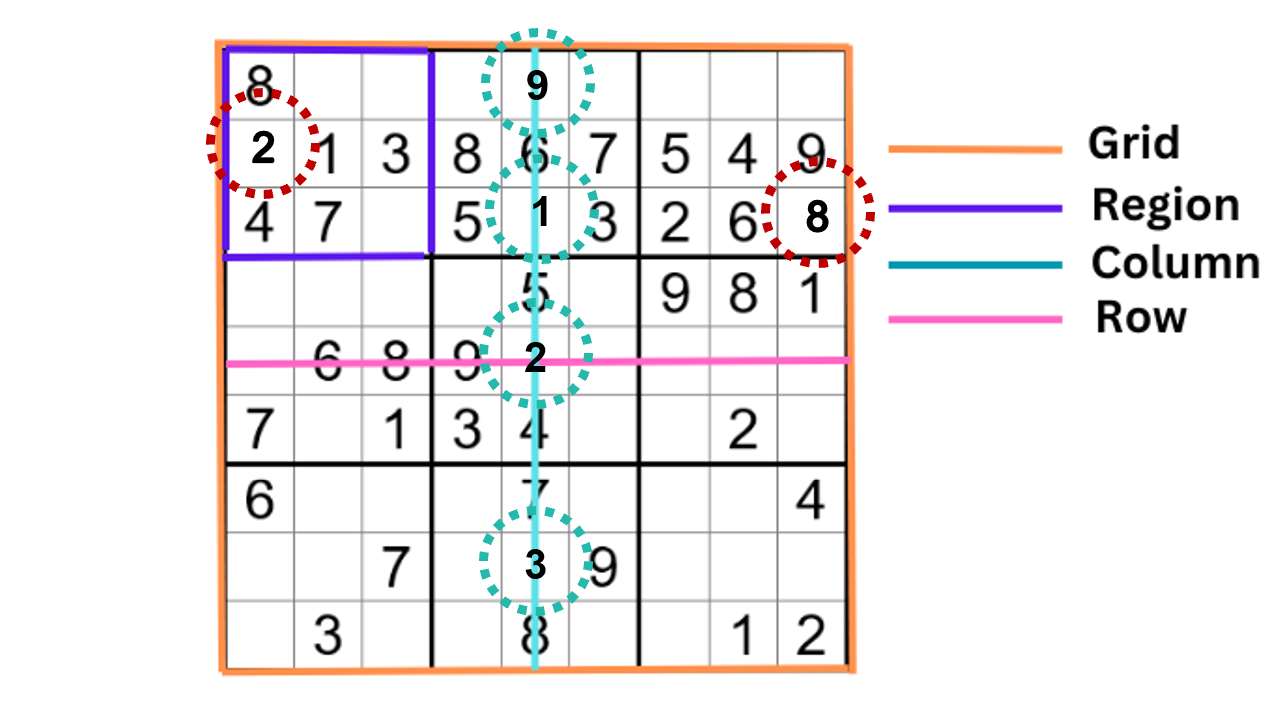
A sudoku puzzle is made up of a grid, regions, columns and rows.
Each region, column and row can only have 1-9 and the numbers cannot repeat.
Example:
In region 1, column 1, row 2: you have all numbers 1-9 except 2. Therefore, you would write in a 2..
In the region 3, column 9, row 3: the only number that will allow no duplicates is an 8. This is because an 8 cannot be in the top row within that region.
Solution for Column 5 - remember use the process of elimination.
A bit of history:
The origin of Sudoku traces back to both mathematics and modern puzzle publishing.
The underlying idea comes from Latin squares, a concept studied in the 18th century by mathematician Leonhard Euler. These were grids arranged so that symbols did not repeat in rows or columns.
The first puzzle recognizable as Sudoku appeared in 1979 in the United States, published by Dell Magazines under the name “Number Place.”
In the 1980s, Japanese puzzle publisher Maki Kaji introduced the game to Japan, simplified its presentation, and named it Sudoku, meaning “single number.” From there, it spread internationally and became especially popular worldwide in the early 2000s through newspapers and puzzle books.